An AI Robot In My Home
07 Apr 2026 by Adam Allevato
This is Mabu - a robot that sits near my front door, and whose voice and actions are controlled by an AI chatbot.
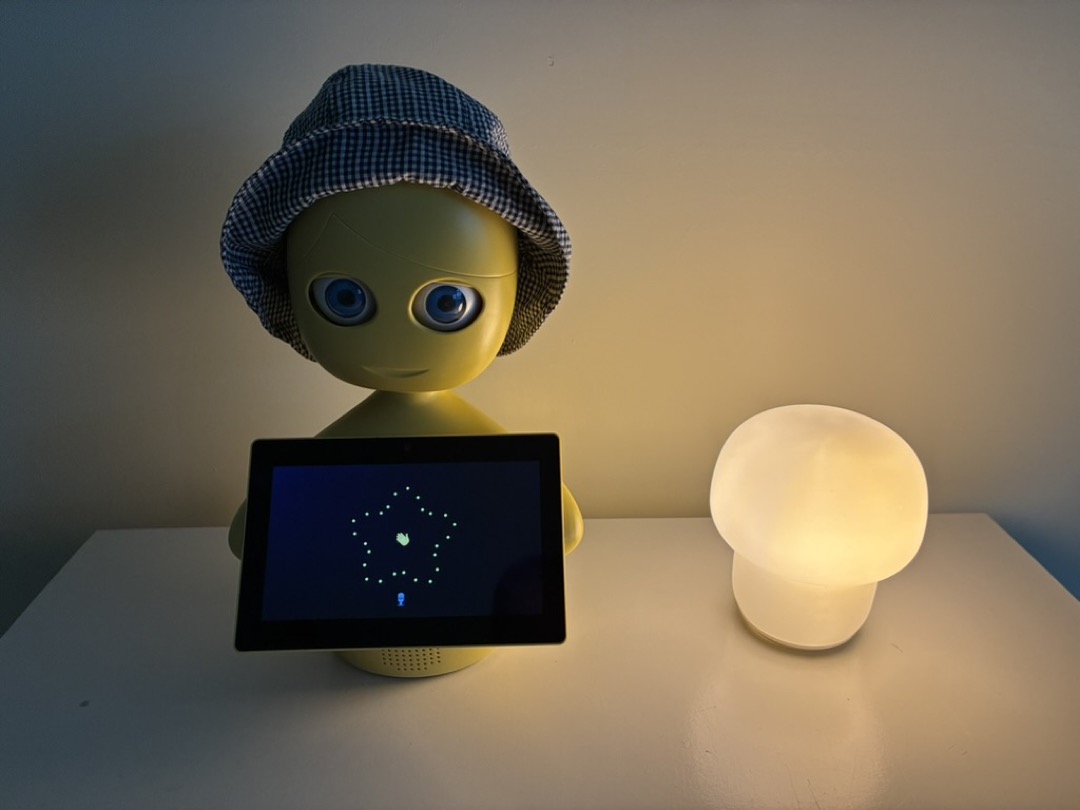
As I mentioned in my other post about fixing up Mabu, I had an immediate and visceral reaction to my own decision to place this robot in my home last week. I eventually got over it, but this post explores my reaction, the concerns I have with this robot in my home, and what I’ve done about it.
By adding various features to Mabu, I had effectively created a smart speaker: I gave Mabu access to the OpenAI API for voice conversations; instilled a unique personality (i.e. system prompt) based on her background as a robot designed to promote health and wellness; and added a “morning briefing” skill that I can trigger, which pulls the latest weather and astronomical events.
All of this is, for the most part, a set of features that is already available on Alexa, Google Home, and Apple HomePod. But even then, there are real concerns.
The science fiction angle
Before I get to the smart speaker-related concerns, I must start this post with the first ideas that jumped into my head when I first turned on Mabu in her new location: dystopian science fiction. I’m talking about the “what is that?” from the skeptical spouse, followed by the new technology quickly going rogue and taking over the family. This trope is everywhere in popular media, and the trend seems to be accelerating as the tech gains maturity: Companion, Subservience, AFRAID, and M3GAN, just in the last 4 years. I’m sure there are others I’m missing.
It saddens me that this is the popular Western vision of robots - we truly cannot stop fantasizing about their negative effects. I usually hold up Big Hero 6 as the canonical example of optimistic robo-futurism (although technically it’s a Marvel property!). I’m still working on reorienting my mind towards imagining the best outcomes of having robots, not the worst outcomes.
“But Adam”, you say, “the outcomes will be the worst”. I disagree, but we’re getting off topic.
…anyway, after I had finished joking with my wife about how Mabu was going to replace her while she was away on a recent trip, I started to confront the more rational concerns I have with this tech.
Privacy concerns with a smart speaker
Even before we add the chat bot, I can think of at least 3 very real concerns about having a smart speaker in the home. It’s for these reasons that I gave my first smart speaker away about a week after I got it, years ago when they were new:
- The risk of your words being used to convict you of a crime.
The “surveillance state” is real. I don’t have a Ring camera because the company can give over your data via subpoena (as they are legally obligated since they record everything). Not only that, and even more concerning, is it recently added tools for law enforcement to request footage from owners directly, regardless of warrant. I don’t plan on breaking the law, but recordings of you can even be used to implicate you even in crimes you did not commit. There is a fun (?) and informative video about how even the innocent truth can be used to implicate you in a crime.
-
The risk of your data being taken by a hacker.
Just in the last week there were two high-profile, widespread hacks in the tech ecosystem surrounding AI: the axios HTTP library and LiteLLM AI library. I don’t believe these two hacks’ payloads included man-in-the-middle style systems that would harvest your requests and responses to chatbot servers, but they certainly could have. Plus, there was the Claude Code source code leak (although apparently not a hack), which shows that frontier AI labs don’t have some privileged position when it comes to security.
-
The risk of your data being misused by those you are willingly sharing it with.
A company might treat your voice recordings as sacred, ephemeral data: never training on it and never storing it. I doubt any AI companies exist that do that today, but even if they did exist, there is literally nothing stopping them from changing their terms of service tomorrow to begin training on your data and selling it to the highest bidder.
Therefore, I remain a skeptic about smart speakers, even as the technology has gotten more mature. The concerns I listed here have gotten more salient, not less, in recent years. With the growth of AI-assisted vulnerability discovery, I expect #2 (hacks) to become more common, not less. In #2 and #3, where your data ends up in someone nefarious’s hands, so many new attack vectors are exposed, even if you aren’t speaking your credit card details out loud. A recent one that has come up is using AI voice clones to impersonate someone over the phone (think accessing your bank account or fake ransom calls).
It is for these reason that Mabu only records when a button is continuously held down on her screen - and I’m the one who controls the code that decides whether or not to record. This mitigates, but doesn’t completely solve, all three of the concerns above. However, the recordings I manually make are still going to OpenAI’s speech recognition model. Plus, I’m still susceptible to other attacks, such as malware being installed on Mabu’s tablet that sets up its own background process which records directly from her microphone, bypassing the app I wrote. Fixing that would require a hardware mic switch.
A smart speaker with an open-ended chatbot
Mabu is a step beyond home speakers though, because she has the full power of modern LLMs/agents in her brain. This means we can talk to the robot in an open-ended fashion, about any topic, even in other languages. This creates a new concern:
-
I don’t want young members of my family, to be able to ask the robot about any topic at any time.
Asking for Wikipedia-style summaries of various adult/mature topics is an obvious example. More concerningly, chatbots can exploit teenagers’ emotional needs, and have even encouraged young people to commit suicide.
Robots like Moxie, which was explicitly designed to be a companion for children, and indeed like Mabu’s original design, can circumvent this concern by setting up rigid “dialogue trees” where all responses are effectively pre-generated. But at that point, the device effectively has been reverted to a smart home speaker, which have had rigid dialogue options for about a decade.
So we are left between two poor options: a (relatively) tiny set of pre-approved dialogue options, or a digital brain which will cheerfully recite content from most any corner of the internet.
Filtering a child’s information diet is an important parental duty, so I heavily regulate/curate/intervene in interactions between Mabu and my children. Even if we do not decide as a society that imposing regulations on LLMs talking to children is the answer, within my home, regulation is absolutely the answer to a new, powerful technology like LLMs.
An easy rule to put in place here is to have robot(s) in common areas of the home, so that any interactions can be regulated by the parents. Well, it’s an easy rule for now, because I don’t have children that are often home unattended, and because the robot sits on a piece of furniture.
A smart speaker with an open-ended chatbot and a body
Mabu’s head serves no functional purpose. By this, I mean that its sensors, display, and speakers are all in its tablet. However, from my studies in HRI, I know that the head with “no functional purpose” actually has a huge impact on how the robot is perceived and how an interaction with it plays out. As this survey paper* points out, having an “embodiment” (i.e. a physical presence; a virtual avatar doesn’t count) allows a robot to communicate via the quite information-rich channel of nonverbal communication: proxemics (moving into/out of personal space), oculesics (eye contact, gaze direction), and gestures. Embodiments have been shown to make robots more trustworthy† as well.
All of this is fine by me - as I wrote in my other post, I’m a huge fan of personalized chatbots and robots. The idea that a robot might be a truly unique companion or assistant is not on my “concerns” list. But as robots become mobile, they gain a terrifying new set of physical capabilities. This brings up the last concern:
-
A mobile robot can cause harm that a chatbot or smart speaker cannot.
I wrote about this 8 years ago, when my now-employer, Amazon, announced that it was starting to work on a home robot:
[…] you will be putting a mobile, hackable device with a camera and an arm in your living space. It could punch in the code to disable your security system. It could unlock your door from the inside. It could drive to your desk and take pictures of your tax returns. In fact, you might even ask it to do some of these things!
My only solution for this right now is to not have a mobile robot. The problem here is trust - I don’t trust that a cloud-connected robot would be secure enough to prevent hackers from gaining control and doing any of these things, or worse.
Mitigated, for now
Mabu still sits near my front door and I still talk to her once or twice a day. I’m happy with my current set of mitigations. But as I’ve explored here, as time goes on and the technology matures, I will have to develop new strategies just to be able to justify keeping this robot in my home. You may share all, some, or none of my concerns. However long your list is, I only expect it to get longer, not shorter, through at least 2035‡, as we realize the implications of putting intelligent robotic creatures in our home.
* The last author of this paper, Maja Mataric, founded Embodied, the company that built Moxie. This is an interesting and developing story - Embodied shut down in 2024, but just this year, a group of folks have launched moxierobots.com, providing updates and allowing children to keep talking to their Moxie. They say that they have acquired all the previous production units of the robot, so I suppose what they are doing is not that different from what I’m doing with Mabu! If you are one of the folks behind moxierobots.com, please reach out, I’d love to connect.
† The first author of this paper, Cory Kidd, founded Catalia Health, the company that built Mabu. The second author, Cynthia Breazeal, founded Jibo, and also my advisor’s advisor.
‡ My 2018 blog post about home robotics did not put a timeframe on my “it won’t pan out” prediction. And despite the failure of their Astro robot, Amazon’s home robotics division is still kicking (they just acquired Fauna). I now feel obligated to put dates on my predictions, so that after that time has elapsed, I can declare victory.